
Catfish in winter: Catfish behavior and fishing methods
Vitali DalkeGreetings, friends and fellow anglers! The winter behavior of the European catfish ( Silurus glanis ) remains one of the most discussed and myth-ridden topics in our community. Many believe that this river giant falls into a deep hibernation with the onset of cold weather and becomes completely unreachable for anglers. However, my years of experience and observations, supported by scientific data from ichthyology, prove the opposite. Today, I would like to explain what really happens to the catfish in cold water and how this knowledge can be used for a successful catch.

Winter fishing for catfish in the river
Physiology and scientific facts about the digestion of catfish
To understand the behavior of the catfish, we need to look at its biology. The European catfish is a poikilothermic (cold-blooded) organism, meaning its body temperature and metabolic rate depend directly on the ambient temperature. Scientific studies show that the critical threshold for the catfish is a water temperature of 8–10 °C. As soon as the temperature drops below this threshold, the fish's metabolism changes drastically.
Particularly interesting data has been provided by ichthyologists who have investigated the enzymatic activity of fish (e.g., in the work of Hilge). It has been found that the activity of the catfish's main digestive enzymes—pepsin and trypsin—drops to practically zero at a water temperature of +5 to +6 °C. This leads to astonishing figures: While the digestion of average prey takes 10 to 24 hours in summer, this process can drag on for 300–400 hours in winter, potentially lasting up to two or three weeks. This is precisely why we observe the so-called "full stomach" paradox in winter: When gutting fish caught in winter, undigested stomach contents are often found. The predatory fish is not starving in the conventional sense; it is simply physically unable to absorb energy quickly, which is why it hunts extremely rarely.

Vitali Dalke caught this magnificent catfish in winter using an underwater float rig with baitfish.
Overwintering pits and social behavior of catfish
With the onset of cold weather, the ancient instinct for group formation kicks in. Catfish leave their summer hunting grounds and retreat to deep channels and holes – their so-called wintering grounds . Here, in the depths, the water temperature remains most stable, staying at around +4 °C, the temperature of water's maximum density. In such places, catfish form dense aggregations and often literally lie on top of each other. Scientifically, this is explained by minimizing energy consumption: within the group, hydrodynamic resistance against the weak current at the bottom decreases, and stress is also reduced. The fish's body is covered with a thickened layer of mucus, which serves a protective function.
 Winter fishing for catfish
The wake-up factor: flooding and strong currents
The claim that catfish remain motionless throughout the winter only applies to still waters or periods of stable ice cover. The situation changes fundamentally in rivers that don't freeze, especially when the water level rises. If a thaw occurs in winter or water is released from dams, the hydrological situation in the riverbed changes drastically. A rise in the water level inevitably leads to a stronger current. For the catfish, which is in energy-saving mode, fighting the powerful current at the bottom becomes energetically disadvantageous and even dangerous. The instinct for self-preservation forces the fish to leave its "wintering spots" and awaken from its torpor. At this moment, the survival mechanism kicks in: having expended enormous amounts of energy on movement and fighting against the current, the catfish is forced to replenish its energy reserves and begins searching for food.

A large catfish. Caught in cold water.
Special features of winter fishing for catfish: rigging and presentation
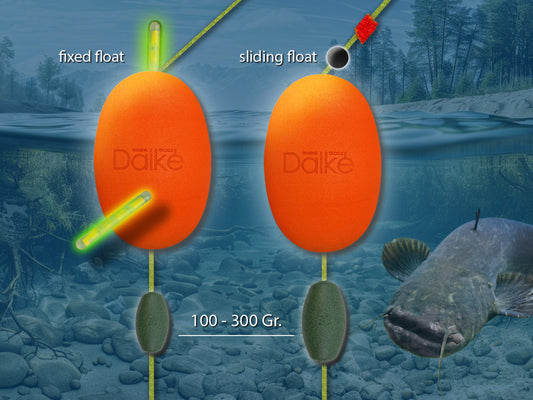
Understanding the predatory fish's sluggish physiological state dictates specific requirements for tackle. In the colder months, when the fish are unwilling to make rapid attacks or ascend the water column, I continue to use a bottom rig with an underwater float (U-float), but with significant adjustments. A critically important element is the leader length . While an active catfish in summer will readily attack a bait present one and a half to two meters above the bottom, in winter it stays close to the seabed. Therefore, I shorten the leaders to 80–100 centimeters . This allows the bait to be presented directly at the fish's horizon, minimizing the effort required for an attack.

Vitali Dalke caught this catfish in February using a U-float rig with a large bream as bait.
Equally important is the precision of the rig itself. The catfish's muscle tone is reduced in winter, its movements are slower, and its bite lacks the summer aggression. It sucks in its prey more cautiously. When using a breakaway rig (snap-away rig), I deliberately extend the breakaway line to up to 40 centimeters and avoid excessive tension on the main line. This allows the fish to take the bait unimpeded into its mouth without feeling the telltale resistance of the tackle in the very first second. Only after the catfish has securely swallowed the bait and begins to slowly turn away does the hook set.
Choosing the right bait for winter catfish fishing
Ichthyological studies on the winter diet of catfish confirm that their feeding in cold water shifts towards benthic (bottom-dwelling) organisms, which can be collected without any hunting. Fishing strategies must be adapted to the current conditions.
During periods of heavy flooding, when the water becomes murky and overflows its banks, the river transforms into a torrent carrying food washed down from the fields. At this time, a large bunch of earthworms is one of the best baits, as worms and washed-up rodents enter the natural food chain. However, if the water level is stable but the temperature is low, I rely on baitfish. I don't choose active fish, but rather calmer whitefish – bream or roach . It's also worth noting that scientists frequently find crayfish and mussels in the stomachs of winter catfish. Therefore, using mussel meat or crayfish (where permitted) is a biologically sound move – it's easily digestible protein that is common in the predator's winter diet.

This catfish bit right in front of the bank when the river was at a high water level.
When water levels are high, catfish often move towards the shoreline, seeking shelter from the current under flooded bushes, in eddies, and backwaters. This also presents opportunities for spin fishing. Slowly retrieving soft plastic lures, heavy spinners, or crankbaits can provoke a reflex strike from the winter catfish.
Activity times of the catfish in winter
An interesting fact, confirmed by my observations, is the shift in the daily rhythm. While catfish are almost exclusively nocturnal predators in summer, their feeding activity often shifts to the brighter daytime hours in winter. Sunny days are particularly promising, as even a minimal warming of the water in shallow areas can activate the baitfish and, consequently, the catfish.

During floods, catfish often hunt in the shallow water of inundated meadows. Vitali Dalke caught this catfish using a fixed-line rig and baitfish.
Winter catfish fishing is a test not only of equipment but also of character. Given their slowed metabolism and long digestive cycle (300-400 hours), catfish feed extremely infrequently. Sometimes you have to wait several days for a single bite. But it is precisely this difficulty that makes winter trophy fish so prized. Catching a river giant under conditions when nature is dormant is the ultimate challenge for the angler willing to defy the elements.
Author: Vitali Dalke