
Why catfish can perceive our fishing hooks
Vitali DalkeWhen metal isn't invisible – Why catfish can perceive our catfish hooks and how coatings are changing fishing
Vitali Dalke (DALKE FISHING)
The hidden sensory world of the catfish
The European catfish lives in a sensory reality fundamentally different from ours. For us, a fishing hook is a small piece of steel, simple, functional, and visually easily identifiable. For the catfish, however, it is an object that leaves chemical traces, can generate micro-electric fields, and may even be magnetically detectable. Because the catfish relies primarily on its highly specialized sensory organs and little on its eyesight, it perceives its environment in a way that is almost unimaginable to us.
This exceptional sensitivity explains why metallic components of a rig are not automatically "invisible" to the fish in the water. Modern catfish fishing must therefore consider more than just bait size, rig shape, or presentation – because the catfish hook itself also sends signals that can be relevant to the catfish.

Chemical Signals – When Metal Meets Water
The skin of the catfish, and especially its barbels, is equipped with an extremely high density of chemosensory receptors. These react to the slightest traces of substances dissolved in water. Metal surfaces release small amounts of ions as soon as they come into contact with moisture. These amounts are insignificant for humans, but they locally alter the chemical composition of the water – and this is precisely what the catfish perceives.
The crucial factor is the chemical interaction between metal and water. A coating acts as a barrier, preventing direct exchange between the hook steel and the environment. This keeps the chemical environment around the lure more neutral and less noticeable to the fish, which often decides whether or not to take a bait at close range.
Electric microfields – the invisible signal in water
Besides chemical stimuli, electric microfields play a crucial role. Metal in water never forms a completely passive element. Galvanic effects, surface reactions, or minimal potential differences can lead to the generation of electrical signals in the immediate vicinity of an uncoated hook. These are immeasurable or irrelevant to us, but clearly perceptible to electrosensitive fish species.
Many catfish species possess electroreceptive structures that can register such microfields. Even if not every electrical stimulus triggers an escape or avoidance reaction in the catfish, it is clear that these signals contribute to its overall perception of the bait. A coating significantly reduces these electrical phenomena, as the direct contact between metal and water is not completely eliminated, but greatly reduced—the hook point must remain free of coatings. As a result, the hook loses much of its electrochemical signature without impairing its function.
Magnetic effects – an often underestimated influence
In recent years, scientific studies have indicated that some catfish species possess magnetosensitive structures. They can perceive changes in the natural magnetic field that surrounds the Earth. A ferromagnetic hook alters these field lines. This doesn't mean that a catfish inherently avoids magnetic objects. However, it does perceive these changes and incorporates them into its decision whether to investigate the bait or reject it.
Here too, the crucial advantage of a coating lies in making the metal more "passive." It is not the material itself, but its direct interaction with water and the environment that makes the fishing hook noticeable. A stable coating does not completely alter the electromagnetic signature, but it does reduce the stimulation intensity at close range.
Two decades of experimentation – in search of the “neutral” catfish hook
My personal exploration of this topic began in the early 2000s. I experimented with various methods: liquid rubber, different varnishes, and even silicone coatings. The goal was always the same – to make the hook as inconspicuous as possible for the fish.

In the early 2000s I started coating my catfish hooks and components.
These coatings rarely lasted long, and the mechanical stress of catfish fishing caused the layers to peel off quickly. Despite their limited durability, however, the tests showed a clear trend. As soon as the catfish hook was no longer bare metal, the bite rate increased noticeably. This pattern was confirmed over the years and across numerous anglers, waters, and conditions. Particularly experienced and large catfish reacted significantly more positively to coated hooks.
Modern technology – a breakthrough for practical application
Many years later, the industry now offers processes that enable extremely durable yet very thin coatings. Some time ago, I came across a process that, for the first time, meets all the requirements we catfish anglers have. The coating adheres exceptionally well and doesn't peel off even under heavy use. Although the surface may appear slightly rough, this is irrelevant to the catfish's sensory perception – what matters is that the catfish hook itself remains insulated.

First hook coating as a test
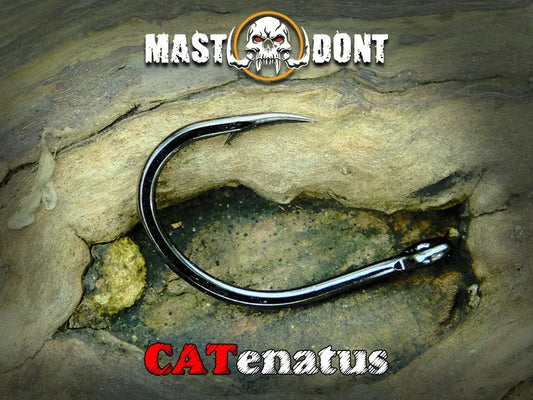
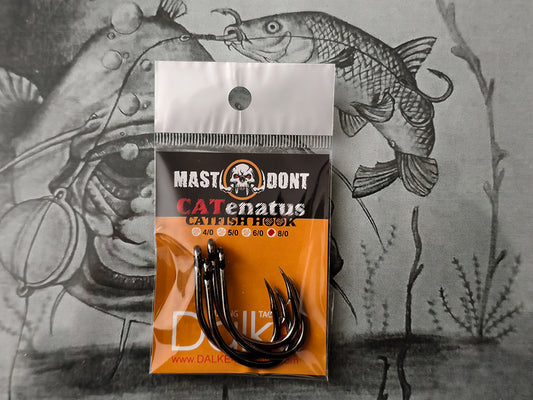
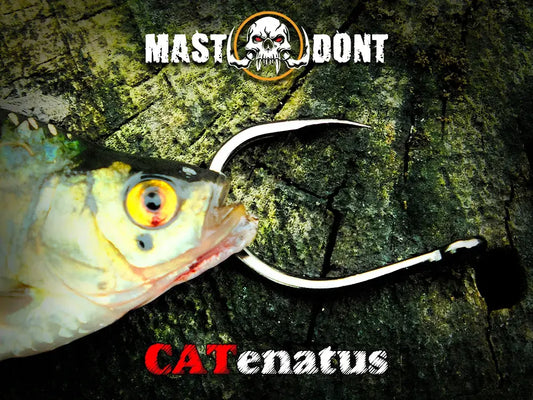
The first samples I tested of the Mastodont catfish hooks were immediately convincing. They behaved inconspicuously in the water, showed no visible signs of wear, and remained stable even after prolonged use. Ongoing field tests confirm these results and paint a clear picture: This coating is a milestone in catfish fishing.

After the testing phase is complete, our Mastodont catfish hooks will also be available in a coated version. For me personally, this marks the end of a long journey from small-scale experimentation to a large-scale technical solution.
Conclusion – The future of catfish fishing is sensorially well thought out.
Metal is never neutral in water. It emits chemical, electrical, and magnetic signals that a highly sensitive fish like the European catfish can detect. A high-quality coating reduces the interaction between the metal and the environment – and it is precisely this interaction that makes the fishing hook noticeable to the catfish.

Modern catfish fishing is undergoing a transformation. We are increasingly understanding that small technical details can make a huge difference. A coated catfish hook is not merely a visual luxury, but a functional tool that can positively influence the catfish's feeding behavior. The combination of biological understanding and modern technology makes this progress possible – and opens up new avenues for us to make our fishing even more efficient and, at the same time, more natural.